Wednesday, December 2, 2015

Module 15: The Absolutely True Diary of a Part-Time Indian


Book Summary

Junior, a cartoonist Spokane Indian, has always been the odd one out. He was born with a list of medical ailments and has been picked on by other Indians on the rez. The only person that would stick up for him was his rough and tough best friend Rowdy. After an incident at his school, he was encouraged and ultimately decides to attend Reardan, the "white school" across town. This is his ticket out of the rez. This action turns those living on the rez against him, especially his best friend Rowdy who now hates him. Junior, aka Arnold, has to navigate the world of his new school and his new, even lower, position on the rez. Just as he starts to find his place at Reardan, tragedy strikes his family. 

APA Reference of the Book
Alexie, Sherman. (2007). The absolutely true diary of a part-time indian. New York, NY: Little, Brown, and Company. 

Impression

This book was one of my favorites that I read this semester. The voice of Junior is so powerful. As a reader, you feel as if you are his friend. The language is crude, but realistic for a high school boy. The illustrations add to the book's charm, emotion, and builds the character of Junior. If I had to describe this book in one word, I would use the word REAL. This book is direct about the problems faced by Indians and Junior. It does not tread lightly in an attempt to spare the readers feelings. This book is one of the top banned books, but I think that is just because people are afraid of that realness. The profanity and crude language in this book is not overwhelming or superficial, it is used exactly how it would be used in real life. As I was reading this book, I was just happily going along and enjoying it. Then BAM. Tragedy strikes. And just like the tragedy in the book, I felt like I was hit by a car. The emotions were unexpected, but I was finally able to deal with them and move on. Then, BAM. Another tragedy. And BAM, again. The end of this book was far more emotional for me than I expected it to be, but I wouldn't change the ending. Fantastic read. I would recommend this to everyone. 

Professional Review

Part memoir, part graphic novel, part humor, and part pure heartbreak is the story of Arnold "Junior" Spirit. The first-person narration gives vivid details about what life is like for a teenager on an Indian reservation. Junior is bullied for not looking or acting like the other kids; his self-loathing voice compels the reader to learn more about this young man. The external conflict intensifies when Junior decides to attend the "white school" instead of the one on "the rez"; he is seen as someone who has rejected his culture and his home. What's worse is the internal conflict when Junior realizes he doesn't quite fit in at the white school, either; he expected to blend in based on intellectual ability but is isolated because of his external qualities. He describes the dichotomy with a brilliant visual (on page 57) that illustrates the dual identities he inhabits: white and Indian.
Unfortunately, Junior is bullied in both worlds and struggles to define himself and come to terms with who he really is. He wonders about the possibilities his life may hold but also fears the obstacles he will face simply because he is an Indian. He is split between these two ideas: the paltry and miserable opportunities on "the rez" just seem to discourage him, yet leaving and seeking out the great unknown is intimidating.
This text is rich in many ways and provides teachers with several topics and themes to discuss, yet the concept of the inner bully could be a powerful one to explore with students. The text is heartbreaking at times while humorous at others; adolescents will certainly enjoy the first-person narrative. Teachers could consider the theme of identity and defining yourself within the context of family, culture, high school, and society.
Schmidt, P. (2014). [Review of the book: The absolutely true diary of a part-time Indian, by S. Alexie]. English Journal: 103(5), 84-84.
Library Uses
One use of this book that I thought about was using it during banned book week. I would definitely include it in a display in a high school or middle school library. Another idea that I would incorporate is to have students read a banned book, including this one, and make book commercials advocating for their book. It would also be a fun book to include in a mock trial event, where students have to argue for or against banning it from the library. 

Wednesday, November 25, 2015

Module 14: All the Broken Pieces


Book Summary

Matt Pin was adopted into an American family after being air lifted out of Vietnam during the Vietnam War. His birth father was an American soldier and his birth mother was Vietnamese. His birth mother was forced to give him up for a better life. Matt plays the piano and becomes the pitcher of his baseball team. Through his coaches, parents, and piano teacher, Matt is guided towards facing his past, the people who treat him badly because of where he is from, the political climate of the time, and his own mistakes he has made. 

APA Reference of the Book
Burg, Anne. (2009). All the broken pieces. New York, NY: Scholastic Press. 

Impression

This is an emotional, powerful book that explores the tensions and misunderstandings that faced our nation after the Vietnam War. I think choosing to write this novel in verse made it more powerful and was the best format for this novel. This is a heavy novel, but one that I feel is needed. The emotions are much better expressed through verse than if it were just a standard novel. Like a strong fiction book, the changes the main character experiences are profound. There are not many books that confront this time in our nation's history and I think it is an important one that needs to be addressed. I also felt that weaving sports and music into this book not only make it more realistic, but show how these forums can help us deal with our emotions and experiences. It's a tear jerker, but a much needed one. 

Professional Review

Seventh-grader Matt is haunted by his past, when his frantic Vietnamese mother, intent on keeping her elder son safe, sent him to America in the Saigon airlift when he was nine. On the surface, he seems to have settled in with his American family—he has joined the baseball team and become its star pitcher, and he's taking to the piano like a duck to water—but he's still tormented by grief and guilt over what he experienced, especially his younger brother's terrible injuries from encountering a land mine when he was under Matt's care. The free-verse text lacks tonal control, veering from sentimentality to flat prosiness to oversophisticated metaphor, and there's some cliché in plot elements such as Matt's misunderstanding of a parental conversation he overhears and his relationship with a racist bully on the team. The book tackles some subjects worthy of exploration, though, ranging from the parallels between the civilian and soldier experiences in the Vietnam War to the difficulty of reconciling a traumatic past with a peaceful present, especially when a child has left family behind; as a picture of older-child adoption, it's refreshing in its acknowledgment of the importance of the child's earlier life. With its accessible writing, this will help it bridge the historical gap for young readers, who may gain new understanding of some of the struggles of the previous generation.
Stevenson, D. (2009). [Review of the book: All the broken pieces, by D. Stevenson]. Bulletin of the Center for Children's Books: 62(9), 35. 

Library Uses
This book could be used in a variety of scenarios: novels in verse, sports books, adoption stories, etc. I think this book would best be served as a study or display on books that have to do with the Vietnam War era. While this piece of history is more current than other wars and historical events, I think it gets some of the least recognition or study. To me, that's unfortunate, as I think a lot of our current political climate can be compared to this time. 

Sunday, November 22, 2015

Module 13: Pyongyang: A Journey in North Korea


Book Summary
This graphic novel tells about the time in Guy Delisle's life that he worked as an animator in the hermit country of North Korea. While the reader gets insight into Delisle's thoughts, feelings, and the work he did while he was there, the black and white illustrations give a feeling of the loneliness and oddness of North Korea. The reader also learns a lot of information about North Korea in another format. 

APA Reference of the Book
Delisle, Guy. (2007). Pyongyang: A journey in North Korea. Montreal, Quebec: L'Association. 

Impression

I was very excited to read this graphic novel because North Korea is big area of interest. I lived for three years in South Korea and have read extensively on North Korea and the issues the divided countries face. I think this was a great format to write this memoir, because the visual elements of it were better communicated than if it was just described. Many of the visuals in this were very powerful. Because I've read a lot on North Korea, there were not many new things that I learned about the country. But I think for someone unfamiliar on the nation, this would be an interesting read. I did not especially like Delisle's style of writing. There were a few underlying jabs towards Asians in general, especially about the Chinese. I'm not sure if this was his intention, but I did not care for this attitude. A huge issue that I took with this book was when he would write in Korea. While, I don't speak or have an extensive Korean vocabulary, his Korean was nonsensical. Some of the characters were not even real characters and many of the "words" he would write wouldn't even include a vowel, so they were not real words. While I don't expect everything to be in perfect Korean, a bit of research and translation would have gone a long way. 

Professional Review

Pyongyang: A Journey in North Korea
by Guy Delisle
Jonathan Cape £12.99, pp184
Comic-book memoirs of life in dangerous locations have become a minor genre. Joe Sacco's Palestine was followed by Marjane Satrapi's Persepolis books, documenting life in revolutionary Iran. Now French-Canadian cartoonist Guy Delisle's Pyongyang chronicles his two-month stay in North Korea, supervising animation work, prior to 9/11.
As a foreigner, severely restricted in where he may travel, much of Delisle's account centres on official landmarks devoted to the state and its glorious leadership. Even a trip to the railway station requires several days' prior notice, and the pocket guide counsels sternly: 'Do not try anything on your own.' Delisle's evocative pencil drawings are suited to depicting a colourless, twilight world in which the state is all, with his rudimentary characters inhabiting vast and much more detailed architectural environments. Less well drawn are the inner lives of Pyongyang's citizens.
Even Delisle's ubiquitous 'guide' and translator remain little more than surfaces, etched only with party propaganda and moments of discomfort. Perhaps this is exactly how people behaved in the author's presence; perhaps they were genuinely inscrutable. Pyongyang effectively conveys a foreigner's experience of this Hermit Kingdom, though one can't help but wonder what lies behind those surfaces, especially now that North Korea has joined the nuclear club.
Thompson, D. (2006). [Review of the book: Pyongyang: A journey in North Korea, by G. Delise]. The Guardian. Retrieved from http://www.theguardian.com/books/2006/oct/15/travel.features

Library Uses
North Korea is a huge area of interest because of the prominence of the country in the news and the mystery that surrounds the hermit country. Pairing this book with The Aquariums of Pyongyang would be an interesting comparison of the memoirs. It would lead to great discussion for a high school reading club.  

Wednesday, November 11, 2015

Module 12: Hank Aaron: Brave in Every Way


Book Summary
This book is the biography of Hank Aaron. It is a narrative account of his life starting at his childhood and ending at him beating Babe Ruth's home run record. The story along with its beautiful illustrations give a lot of information and facts about Hank Aaron's life, struggles, and successes. 

APA Reference of the Book

Golenbock, Peter. (2001). Hank Aaron: Brave in every way. Orlando, FL: Gulliver Books. 

Impression

This book was well written--interesting, yet simple enough to understand. It weaved facts seamlessly into an intriguing narrative about Hank Aaron. It reminded me a lot of a favorite picture book biography of mine--Roberto Clemente: Pride of the PittsburgPirates. The book did not include an author's note or any information about references, but it was clear throughout the writing that the author did do a lot of research before writing this book. I felt the author did a good way of addressing the negative attention and death threats that were received by Hank Aaron, but in a very age appropriate way. 

Professional Review

GOLENBOCK, PETER. (2001). Hank Aaron: Brave in Every Way. Illus by Paul Lee. San Diego: Harcourt. ISBN 0-15-202093-4.
    When Hank Aaron was born his father wanted him to know the joy of playing baseball and his mother wanted him to make a difference in the world. Hank did both of these things. Hank Aaron played baseball in the major leagues and in 1974 he broke Babe Ruth's homerun record.
    This biography would be interesting to cluster with several other recent baseball biographies such as Lou Gehrig: The Luckiest Man (Adler, 1997), Satchel Paige (Ransome, 2000); and Golenbock's earlier book, Teammates (1992) about Pee Wee Reese.

Brewer, J. & Bushner, D. (2002). Spotlight: nonfiction [Review of the book Hank Aaron: Brave in every way, by P. Golenbock]. New England Reading Association Journal: 38(2), p. 35.

Library Uses
This book could be used in a variety of purposes. It could be included in a biography study. I would highly recommend it to teachers looking for a mentor text for writing a biography. It would be a strong book to include when studying sports stars or African American history. Additionally, it could spark a discussion about how illustrations influence a story and provide information just through pictures. 

Sunday, November 8, 2015

Module 11: Zombie Makers: True Stories of Nature's Undead

Image result for zombie makers book

Book Summary
We all know that the zombies we see in popular culture are not real, but there are zombie makers out there among us! This book tells about creatures, parasites, and fungi that take over the bodies and brains of other creatures. The book uses flashy graphics, references to pop culture, well researched facts, and shocking pictures to engage the reader into learning more about these little known creatures. 

APA Reference of the Book
Johnson, Rebecca. (2013). Zombie makers: True stories of nature's undead. Minneapolis, MN: Milbrook Press.

Impression

This book has all the elements of a popular and well done informational book. It is visually appealing. Uses text features to engage the reader and provide them with visually interesting information. The book is very well researched and as flashy and visually appealing as it is, it has even stronger scientific research and information behind it. I can just see this book flying off the shelves to upper elementary students. However, I did not like it! The pictures completely grossed me out and while the information was presented well, learning about undead animals is certainly not something I want to spend my time doing. I have a pretty big fear of raccoons. The chapter about the rabid racoons was way too much for me. While I would never want to read this book again, I would certainly have it in my collection. 

Professional Review
With the popularity of zombie books and movies today, can you imagine a student’s excitement when seeing this title? How cool! And it’s not science fiction, it’s science…carefully researched and documented. Zombie makers, which may be a fungus, parasite, insect, or worm, take control of animals by injecting them either through the bloodstream or brain and making them their zombie “slaves.” Clear, close-up photographs (some on a microscopic level) document both the process of paralysis and the results, which are described on a behavioral as well as a cellular level. After the general description of the zombie-making process, there is a section titled “The Science Behind the Story.” The biology and physiology of the process are described at a middle school level so that students can understand not only the zombie makers’ behavior and life-cycles, but also what is happening internally in the host animals. As an added bonus, the scientists who researched the phenomena are documented and their experiments and research activities described. I highly recommend this book, which will appeal to all readers. Teachers, please give your students a chance to enjoy this book, too!
Schoen-Giddings, L. (2013). Zombie makers: True stories of nature's undead. Science Scope, 36(7), 108. 
Library Uses
While I can see this book flying off the shelves, it would also be a great book to focus on in a display to lead students to other similar books. Zombies are currently very popular in pop culture right now. Librarians could capitalize on it to create a zombie themed display to draw students into the library. Other titles to consider including would be: Diary of a Zombie Kid, anything from the Zombie Chaser series, My Big Fat Zombie Goldfish.

Sunday, November 1, 2015

Module 10: Tomas and the Library Lady


Book Summary
Tomas and his family are migrant workers that travel from Texas to Iowa for work on farms. In the summer, his family goes to Iowa. Tomas likes to sit under the tree with his grandpa and listen to his stories. While in Iowa, Tomas visits the library. He falls in love and visits the library every day. He reads stories and improves his English, with the help of the special librarian. He is taken to faraway lands and adventures through reading. He goes home and shares with his grandpa the stories he reads. When it is time to return to Texas, he takes his grandpa to visit the library and librarian one last time. The librarian speaks the Spanish she has learned from Tomas and gives him a book to take with him. He reads it to his grandpa on their trip back to Texas. 

APA Reference of the Book

Mora, Pat. (1997). Tomas and the library lady. New York, NY: Alfred A. Knopf, Inc.

Impression

This book has always been popular with my colleagues, but until this week, I had never read it. I really enjoyed the way it presented the worlds that can be opened up to you from reading. The illustrations were realistic, but also brought a bit of fantasy that worked perfectly with the story. It shows how important reading and education can be for your future success. Tomas Rivera became a very important figure in the Latino community and this book shows how important education is to this. It is not preachy or seems like it is teaching a lesson. It is just a charming story about a young boy, his grandfather, and a librarian. 

Professional Review
Pat Mora's Tomas and the Library Lady (Illus. by Raul Colon. Random House, 1997) is based on a true incident that happened in the young life of Tomas Rivera, famous writer, educational leader, and university president at the University of California at Riverside. Tomas, the son of migrant farm workers, goes to a public library in Iowa in search of more stories like Papa Grande tells. Until Tomas must return to Texas at the end of the summer, his love for stories and books is nurtured by "the library lady."
Two other books that depict this special love for the library and reading are Patricia McKissack's Goin' Someplace Special (Illus. by Jerry Pinkney. Atheneum, 2001) and William Miller's Richard Wright and the Library Card (Illus. by Gregory Christie. Lee & Low Books, 1999). Goin' Someplace Special is the story of Tricia Ann, a young African American girl in the 1950's segregated South who is on her way to one place where all are welcome-the public library Richard Wright and the Library Card is a fictionalized account of an event from the autobiography of well-known African American writer of Black Boy and Native Son. Wright grew up in the South in the 1920s and, though he couldn't obtain a library card of his own in Memphis, he borrowed one from a white man and used it under the pretense of checking out books for the man.
Brodie, C. S. (2003). Connect the book: Tomas and the library lady. School Library Media Activities Monthly, 19(9), 48-48,51. 

Library Uses
This book, in my opinion, should be included in any study on Hispanic or Latino history study. Additionally, I think it is a perfect mentor text for writing personal narrative and would share it with teachers looking for authentic literature to use in their writing workshop. The Zach Scott Theater in Austin is running a production of this in early 2016 and it would make a great field trip to take students on to watch the play. 

Saturday, October 24, 2015

Module 9: The Case of the Case of the Mistaken Identity


Book Summary
In The Case of the Case of the Mistaken Identity, Steve Brixton takes on his first adventure as a detective. After being assigned a research paper by his Social Studies teacher, Ms.Gilfeather, he has to check out a book on American Needlework. After checking out American Needlework, starts a chain reaction that sets the police and the Librarians, a secret U.S. agency, on Steve Brixton's trail. Steve Brixton uses The Baily Brother's Detective Handbook to help him solve the case and sort out the true identity of Mr. E. 

APA Reference of the Book

Barnett, Mac. (2009). The case of the case of the mistaken identity. New York, NY: Simon & Schuster Books for Young Readers. 

Impression
I really enjoyed this book. It was engaging, clever, and campy. The book was suspenseful and kept the reader engaged in figuring out the mystery until the very end of the book. I was able to hear Mac Barnett speak at the International Literacy Association Conference this summer. He talked about his favorite books growing up which were Nancy Drew and The Hardy Boys. It is very apparent that those books were a huge inspiration for this book. Additionally, I always am looking for a good series to hook young readers and keep them interested in reading them all. These series would definitely be kept in my library's collections. 

Professional Review
Kid walks into your library. Says he wants a mystery series. A new mystery series. You hand him Encyclopedia Brown. He withers you with a glance. You hand him Enola Holmes. His upper lip curls at the female protagonist (it happens). You hand him a recent Hardy Boys where they fight terrorists. He looks at you like he may be seriously doubting your sanity. You finally hand him The Case of the Case of Mistaken Identity by Mac Barnett, the first in The Brixton Brothers series. He sighs in relief and then asks for the other books in the series. You tell him there is only one out right now. He kicks you in the shins. And, ladies and gentlemen, this little drama is soon to play out your home town any minute now. Countless young hoodlums will instantly find their desire for mystery and snarky self-aware writing satiated by this Mr. Barnett, only to find themselves infuriated by the (as of this review) lack of subsequent novels in the series. Reports of the death of the boy detective novel have been greatly exaggerated. It lives on the only way it can in this day and age; with a wink and a nod.
If there’s one thing Steve Brixton knows about it’s detective work. And why wouldn’t he? A fan of the great Bailey Brothers book series, Steve is pretty confident that in the event of a crime he’d definitely be the one to solve it in the end. So all things considered, he’s probably the perfect fellow to be mistaken for an evil spy. That’s just what happens when Steve goes into his local library to check out a book on quilting for a school project. Next thing he knows, Steve’s discovered that all librarians belong to a highly specialized force of undercover agents and he has, unwittingly, pitted himself against them. Now he has to clear his name and find out the true villains before the librarians get their hands on him once and for all.
It’s funny. Funny is hard. I don’t mean to say that there aren’t plenty of books for kids out there that are funny. Sure there are. But to write a funny book is to write a story that sustains its humor and still manages a satisfying ending, which is no small potatoes. Fortunately Barnett, who has seemingly appeared out of the ether itself, has a style that amuses both kids and adults simultaneously, without talking down to either of them. His writing will undoubtedly catch you unawares. It’s all in the details. For example, at one point we read, “Steve hated fish. He hated the way they tasted and the way they smelled, but more than anything he hated the way they looked. The problem was in the eyes. There was no difference between the eye of a dead fish and the eye of a live one.” Beautiful. In the same vein the next chapter begins by describing a villain as “a nasty, brutish, and short man.” That’s for the adults.
Now in this book Steve spends much of his time attempting to imitate his beloved book-based heroes, only to find himself failing at almost every turn. Tightening your muscles when you’re tied with ropes so they’ll slip off when the villains leave? Doesn’t really work. Throwing a punch? Not as easy as it sounds. Eventually we get the feeling that the author of these Bailey Brothers books must be a bit of a lazy lou since half the time the boys are rescued at the last minute by their day anyway. Barnett has managed to capture the feel of the old time boys’ adventure novel but has done so without sacrificing our modern logic and sensibilities. It’s sort of what M.T. Anderson keeps trying to do with his Whales on Stilts series without ever quite getting it right. Barnett walks the line and he walks it well.
When Alcatraz Versus the Evil Librarians came out I found it pandering. Which was an odd reaction because if there’s anything that doesn’t pander to librarians, it’s calling them evil in the title of a book. Still, I wasn’t buying it. Put the word “librarian” in a title and it’s like my fellow brethren are instantaneously hypnotized into buying the book. “I don’t know what it was about that story. I just had to get forty copies for my branch!” The best case example of this isThe Boy Who Was Raised by Librarians. Shameless doesn’t even begin to cover it. So I’m giving an extra 25 points to this book for not saying “library” or “librarian” anywhere in the title. Granted the cover image shows special ops rappelling into a reference section, but that’s forgivable. And Barnett does lay it on pretty thick when he turns librarians to a covert operation that puts the CIA, the FBI, and M5 to shame. Clearly Mr. Barnett has never had the pleasure of watching a room full of MLIS degrees debate the relative merits of doing storytimes in the morning verses doing them in the afternoons of a given weekday. Trust me, we’ve bigger fish to fry than mere international intrigue. Anyway, Barnett protects himself from accusations of true pandering when he makes fun of READ posters. We’ll give him credit there.
The book has the most obvious similarities to The Hardy Boys, of course. Steve’s belovedBailey Brothers are essentially Frank and Joe renamed Shawn and Kevin. But as for this book itself, I saw hints of other boy detective novels lurking in the corners. For example, early in the story Steve listens as his mother’s new boyfriend, a cop, recounts a crime happening in town that has the police stumped. The chapter ends with Steve saying, “I’m not sure the thief is even a human.” Now if that isn’t Encyclopedia Brown all over, I don’t know what is. You half expect to see at the bottom of the page the sentences, “Why was Steve so sure the thief wasn’t a human being? Turn to the back of the book for the answer!” Instead, Steve gives his reasons and, as with the rest of the book, your expectations are upset. Instead of praising him for his ingenuity, Rick the cop just guffaws at what, ultimately, is the correct solution. Steve is simultaneously under and over estimated throughout this book. Usually you get only one or another when you read a mystery novel for kids. Spices things up a bit when you get both (and a variety of different kinds of detective tales as well). Plus I love that rather than tiptoe around the issue of how unlikely it would be for adults to take a kid like this seriously, Barnett rams into the issue with gusto and devil take the consequences.
Pairing illustrator Adam Rex with Barnett seems obvious now and, let’s face it, probably seemed obvious right from the start to everyone involved with this project. He’s precisely the kind of man you want working on a book of this sort. Rex’s pen-and-ink drawings can be cartoonish one moment and then drawing beautifully incomprehensible technical diagrams (knot-tying, anyone?) the next. The man has range and range is what you want when you hope to mix realism with outright goofiness. Plus Rex is funny in his own right without distracting from Barnett’s humor. When you see that picture of Steve standing in the doorway of a rough bar in a ridiculous sailor costume, the outfit is funny but even funnier are the tough guys who have also stopped to stare at him. The captions on the photos, besides adding a nice retro feel, are the icing on the cake.
I’m immature enough that I was pleased with myself when I guessed the villain correctly, long before the end of the book. I am also thirty-one, so I probably shouldn’t feel as good about that as I do. Still, if you’re in the neighborhood for a great new mystery series with a tongue stuck so far into its cheek that it’s practically coming out its ear, this is it. Modern to its core but still a good mystery and action adventure novel, this is one of the smartest little books I’ve seen in a long time. 21st century kids are gonna adore it. Guaranteed.
Bird, E. (2009, September 26). Review of the day- The Brixton Brothers: The case of the case of the mistaken identity [Review of the book The case of the case of the mistaken identity]. School Library Journal. Retrieved from http://blogs.slj.com/afuse8production/2009/09/26/review-of-the-day-the-brixton-brothers-the-case-of-the-case-of-mistaken-identity/
Library Uses
I would use this series to help highlight mystery books and make comparisons to classic books in the genre. If young readers now are interested and engaged in these books, it would be an easy connection to introduce them to older mysteries such as The Hardy Boys and Nancy Drew Mysteries. 

Sunday, October 18, 2015

Module 8: Doll Bones


Book Summary
Zach, Poppy, and Alice are longtime friends that have been playing a long running imaginative game with their toys. This game includes magic, pirates, princesses, thieves, and many other fantasy elements. The Great Queen is a bone-china doll that rules the game. Now that the three students are in middle school, they are beginning to drift apart due to differing interests. Zach's father, in an effort to make Zach grow up, throws out the toys. Instead of telling the girls the truth, Zach tells them he never wants to play again. Poppy begins to have dreams that the Queen wants them to return her to her grave. She convinces the friends to set off on an adventure to return the Queen to her grave three hours away. The adventure does not go according to plan and the three friends find themselves in some trouble along the way, but in the end find the importance of their friendship as they change.

APA Reference of the Book
Black, Holly. (2013). Doll Bones. New York, NY: Scholastic Inc.
 

Impression

I am not a huge fantasy fan and was not really looking forward to reading this book. However, I ended up enjoying the book much more than I though. The fantasy elements of this book were subtle and used to drive the plot, but not necessarily the focus of this book. The book was more focused on the three main characters, their friendship, and how those relationships change and grow as young people mature. The Queen and the possible haunted aspect made the story more interesting, but did not distract from the main theme of this piece. I think that young people looking for a "scary" book will be disappointed with this book. In my opinion, the cover is by far the scariest element of the book. That being said, I thoroughly enjoyed the book, would recommend it to patrons, and include it in my library's collection. 

Professional Review
The shadowy threshold that lies between the fancies of childhood and the realities of the adult world can be awfully difficult to navigate, and that’s precisely where best friends Zach, Poppy, and Alice find themselves as they make their way through middle school. For years now, their friendship has centered on “the game,” a roleplaying fantasy in which the three pals bring out their best action figures and dolls and pretend to be various heroes and villains going on glorious adventures. Their fun abruptly comes to a halt when Zach’s father throws his dolls in the trash and informs him that it’s time to grow up; though furious, Zach feels his father may be right and ignores his friends’ pleas to return to the game. Poppy won’t give up so easily, however, and convinces Zach to join her and Alice on a last mission: one of her dolls has been visiting Poppy in her dreams, and Poppy believes the doll holds the spirit of a murdered girl who must be put to rest.
Black manages a careful balancing act of reality and fantasy, using the effectively creepy ghost story as the backdrop to a poignant exploration of what is lost along the way to adulthood. The dreamlike quality of the fantastical journey the kids undergo, pirating a dinghy on a local river and indulging in sweets-only meals, is superimposed against the urban decay of an economically depressed town, reminding readers that not all stories, especially in the real world, have happy endings. Indeed, reality can be quite painful for our heroes: Zach’s rage at his father comes as much from his father’s prolonged absence and sudden reappearance as his trashing of Zach’s dolls; Poppy’s exhausted parents barely notice her among her raft of siblings; Alice struggles to please her overbearing grandmother. The game offers each of them a refuge, and when Zach’s plan to quit and deprive the game of its hero alters the landscape of their pretend world, it’s not so much the magic of that place that the friends fear losing but its safety.
The threat that their looming adulthood carries is apparent in the story of Eleanor, the girl whose ghost who may be inhabiting the doll they call the Queen. It’s never quite clear if the ghost is real or merely another product of Poppy’s imagination, and the ambiguity creates a sinister and slightly disorienting air. The real Eleanor’s death as an adolescent, murdered at the hands of an unpredictable force, is a childhood fear come to fruition: that bad things can and do happen in ways that defy the safe conventions of storytelling. The efforts of Zach, Poppy, and Alice to set things right for Eleanor therefore feel wonderfully, if a bit hopelessly, naïve, lacing the bravery of their quest with a touch of melancholy.
The emotional journey is as satisfying as the actual adventure: the aforementioned pirating of small boats, along with midnight bus trips, narrow escapes [End Page 451] from well-intentioned librarians, and graveyard searches will keep readers turning the pages, even the tweens who yet experienced the sturm und drang of adolescence. Those readers who have weathered the storm, however, and who are mourning the world they once inhabited will find a kindred spirit in Poppy, whose lament, “I hate that everyone calls it growing up, but it seems like dying,” is keenly felt by nostalgics everywhere. (See p. 454 for publication information.)
Quealy-Gainer, K.(2013). Doll bones by Holly Black (review). Bulletin of the Center for Children's Books, 66(10), 451-452. The Johns Hopkins University Press.


Library Uses
While I do not think this book is necessarily "scary," there is definitely a creepy element to it. I would include it in a "spooky" display around Halloween to encourage students to read higher quality literature than some of the typical Halloween books. In that display, I would also include The Night Gardener and The Sinister Sweetness of Splendid Academy.

Sunday, October 4, 2015

Module 7: Junonia


Book Summary

For her birthday every year, Alice and her family take a trip to Florida and stay in a beach side cabin called Scallop. From the moment she arrives, Alice learns that this trip, for her tenth birthday, will not be the same. Some of her favorite people that usually are there will not be able to come. Her Aunt Kate is coming but bringing her new boyfriend and his daughter Mallory. Mallory does not seem happy about being at the beach and has constant outbursts and tantrums about various things. Alice eventually learns that Mallory's parents are going through a divorce and her mother has moved to France. Although Alice's tenth birthday does not go exactly as planned, in the end, Alice shows a level of maturity and learns empathy towards Mallory. 

APA Reference of the Book

Henkes, K. (2011). Junonia. New York, NY: HarperCollins.
 

Impression

I was pretty disappointed in this book. I really loved Olive's Ocean by Kevin Henkes. When I started the book, it had the same feel, so I had high hopes. This book wasn't bad; I would classify it as average, but I definitely wanted more from it. I found the characters to fall a bit flat. There was not much development of them or of the rising action. My impression of Alice is that she was a privileged child who had never experienced any type of real struggle. Everything she was over dramatically upset about was a "first world problem." There was mentions of some type of facial deformity, but it was never addressed. I think had that been more developed, my opinion of her would have changed and the story would have been more interesting and engaging. Mallory was the most complex character, but she was quickly pulled away from the end of the story and the reader never got to find out how her character fully changed. The setting of the book and descriptions Henkes used were phenomenal and the best part of the entire book. The setting was so developed and weaved throughout the entire book that it became another character, and in my opinion, the best developed. 

Professional Review

Every February, Alice and her family leave their wintry Wisconsin home for the sunny shores of Florida on a week-long vacation that usually falls right around Alice's birthday. This year is going to be extra special as Alice turns ten, and she's looking forward to celebrating with her fellow snowbird neighbors, whom she considers to be her extended family. From the minute she arrives, however, things are different: Mr. and Mrs. Wishmeier's grandchildren won't be visiting due to school, another friend is snowed in back in New York, and Aunt Kate—Alice's favorite relative—is bringing her boyfriend and his spoiled six-year-old daughter, Mallory. Perfectly capturing a girl on the verge of adolescence, Henkes offers up a quiet and, at times, almost mournful tale about the loss of simple childhood magic and the inevitable arrival of adulthood. Well loved and sheltered, Alice is just beginning to peek out at a world beyond her parents' arms, and what she finds is both exhilarating and unnerving. The independence, for example, to search the beach for shells by herself is wonderful, but the specter of loneliness and abandonment, as represented by Mallory and her wayward mother, weighs heavily upon a thoughtful Alice. The story ends on a hopeful note as Alice steps into her role as the older, wiser child through her friendship with Mallory, but an underlying thread of grief, simple and unaffected, remains palpable even at the conclusion. Readers who find themselves reluctant to leave behind the comforts of familiarity, even as they yearn for freedom and excitement, will readily relate to Alice's dilemma. Black-and-white line drawings gently textured with hatching open each chapter.


Quealy-Gainer, K.(2011). Junonia (review). Bulletin of the Center for Children's Books, 64(10), 472.
 

Library Uses

Kevin Henkes has such a wide range of styles. His novels are so different than Caldecott winning picture books. All of these are so different than his most famous books such as Chrysanthemum, Owen, and Lilly's Purple Plastic Purse. I think he would be a great author to highlight in a display to encourage children of all ages to check out his wide range of work. This book would be a great addition because it is appropriate for third or fourth graders. 

Wednesday, September 30, 2015

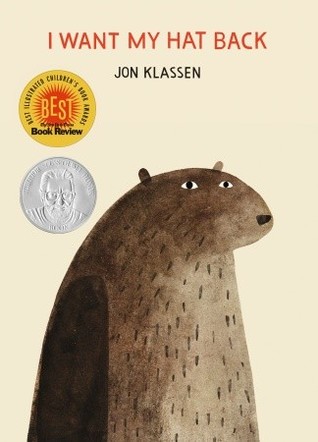
Module 6: I Want My Hat Back


Book Summary
In this book, a bear is on the search for his beloved hat. He makes his way through the forest stopping other animals inquiring about at, until suddenly he realizes that he's already seen it!

APA Reference of the Book
Klassen, J. (2011). I want my hat back. Somerville, MA: Candelwick Press. 


Impression
I was first interested in reading this book because I had really enjoyed the companion book This is Not My HatFor younger students, I initially liked this book because of the repetition. But as I continued through the book, I, as an adult, thought this book was hilarious. I love the dialogue, especially from the guilty rabbit. The humor in this book is very dry, which is the type of humor I find very funny. The way Klassen uses the use of red in his illustrations to move the plot along is very clever. 

Professional Review

An original and dark picture book. Although the illustrations are static with only occasional bursts of energy they are powerful and engaging and have a wonderful clarity. The bear has lost his beloved hat, a little triangular red hat, and he asks many of his neighbours if they have seen it. All deny any knowledge of it including the rabbit who seems to be actually wearing it. The bear, not too observant, does not notice and then his vision of the rabbit suddenly returns--on an inspired all red page--and he storms off to locate the offending creature.
Jon Klassen is a Canadian illustrator and animator. His book has received much praise in the US and Canada where it was published shortly before Walker's UK edition. It seems certain that it will create great interest and receive similar praise on this side of the Atlantic. Jon Klassen is to be welcomed into a select group of picture book storytellers with a unique illustrative style. The book can be thoroughly recommended over a wide age range.

Holloway, M. (2012). Klassen, Jon: I want my hat back. School Librarian, 60(1), 27.

Library Uses
This would be a great book to do for an upper elementary read aloud. As students get older, there is pressure to have library lessons that are useful and applicable to skills that will be used on STAAR. This book would be excellent in teaching students how to infer, use dialogue and add tone to their writing. 

Saturday, September 26, 2015

Module 5: I'll Give You the Sun


Book Summary
I'll Give You the Sun tells the story of Jude and Noah, two twins that lose their mother. After the loss of their mother, they also lose themselves, their relationship, and their identity. The story tells the story of how all this lose occurs and how they get it back, in the end. Noah is scarred by not getting into the art school he wanted and struggling with his sexual identity. Jude struggles with the loss of her virginity and her failure in art school. They both are haunted by the decisions they've made in the past, how it affected their relationship, and how their relationship with their mother was at the time of her sudden and tragic death.

APA Reference of the Book
Nelson, J. (2014). I'll give you the sun. New York, NY: Dial Books.

Impression
This is hands down the best book I've read in this class. I adored how Jandy Nelson built all the characters, chipping away at them piece by piece, exposing more and more about them as a reader. Nelson was able to weave so many themes brilliantly together: family relationships; suicide; coming of age; being true to yourself; divorce; sexuality; falling in love; addiction. It never seemed like she was trying too hard to include all of these, it just worked. And it worked brilliantly. I stayed up way later than I should while reading this book, not because I needed to finish reading it, but because I wanted to. I've read a lot of good books lately, but this was on another level. There's a handful of books that I classify as "the last book." When I finish those books, I don't want to read another book for awhile. I'm afraid if I read another book, it's going to cleanse that book out of my system and I want to stick with this book forever. I want to feel the way I'm feeling when I finish this book forever. I want this to be the last book I ever read. I felt this way when I finished, I'll Give You the Sun. 

Professional Review
Artistically gifted twins Jude and Noah were once inseparable, but now barely communicate following two traumatic events, the death of their mother in a car accident and Jude gaining the place at Art College that Noah, with his mother's encouragement, considered his. The dramatic rift between the twins is mirrored in the dual perspective narration, split between the voices of the 13-year-old Noah and the 16-year old Jude. This narrative device takes a while to get used to but becomes increasingly effective as the two viewpoints show different slants on key events and characters and throw light on the complex and powerful connection between the siblings.
The book explores the vivid inner lives and artistic creativity of the twins as well as their burgeoning sexuality as Noah begins a tentative gay relationship and Jude's connection with a fellow art student gradually begins to erase her memories of a bad early sexual experience.
This is a complex and emotional novel written in heightened, visual language. It has many intertwined themes, art, love, jealousy, loss, betrayal, guilt and reconciliation. The dual narration, from different voices and times, gradually reveals more and more of the interlocking plot and of past family mysteries and secrets. These revelations, particularly about their parents' relationships, mean that the twins are finally honest with themselves and with each other and learn that life is complicated and that blame can be shared.
This tense, moving and vivid Y.A. novel should appeal to older teenage readers who love to immerse themselves in character, language, art and emotion.

Roe, Su. (2015). Nelson, Jandy: I'll give you the sun. School Librarian, Summer 2015, 126. 

Library Uses
If I had a YA book club in my library, this would most definitely be on the must reads for that club. It has so many themes that teenagers can connect to and I believe the discussion would be so rich. I also think the art aspect of this book would be a jumping off point for encouraging interested members of this book club to join art classes held at the library.