Wednesday, September 30, 2015

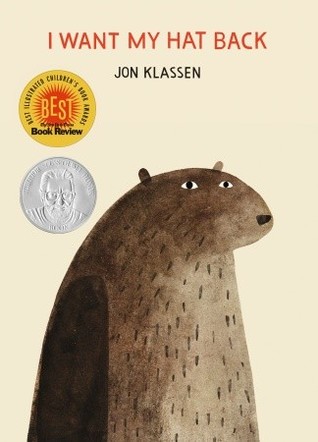
Module 6: I Want My Hat Back


Book Summary
In this book, a bear is on the search for his beloved hat. He makes his way through the forest stopping other animals inquiring about at, until suddenly he realizes that he's already seen it!

APA Reference of the Book
Klassen, J. (2011). I want my hat back. Somerville, MA: Candelwick Press. 


Impression
I was first interested in reading this book because I had really enjoyed the companion book This is Not My HatFor younger students, I initially liked this book because of the repetition. But as I continued through the book, I, as an adult, thought this book was hilarious. I love the dialogue, especially from the guilty rabbit. The humor in this book is very dry, which is the type of humor I find very funny. The way Klassen uses the use of red in his illustrations to move the plot along is very clever. 

Professional Review

An original and dark picture book. Although the illustrations are static with only occasional bursts of energy they are powerful and engaging and have a wonderful clarity. The bear has lost his beloved hat, a little triangular red hat, and he asks many of his neighbours if they have seen it. All deny any knowledge of it including the rabbit who seems to be actually wearing it. The bear, not too observant, does not notice and then his vision of the rabbit suddenly returns--on an inspired all red page--and he storms off to locate the offending creature.
Jon Klassen is a Canadian illustrator and animator. His book has received much praise in the US and Canada where it was published shortly before Walker's UK edition. It seems certain that it will create great interest and receive similar praise on this side of the Atlantic. Jon Klassen is to be welcomed into a select group of picture book storytellers with a unique illustrative style. The book can be thoroughly recommended over a wide age range.

Holloway, M. (2012). Klassen, Jon: I want my hat back. School Librarian, 60(1), 27.

Library Uses
This would be a great book to do for an upper elementary read aloud. As students get older, there is pressure to have library lessons that are useful and applicable to skills that will be used on STAAR. This book would be excellent in teaching students how to infer, use dialogue and add tone to their writing. 

Saturday, September 26, 2015

Module 5: I'll Give You the Sun


Book Summary
I'll Give You the Sun tells the story of Jude and Noah, two twins that lose their mother. After the loss of their mother, they also lose themselves, their relationship, and their identity. The story tells the story of how all this lose occurs and how they get it back, in the end. Noah is scarred by not getting into the art school he wanted and struggling with his sexual identity. Jude struggles with the loss of her virginity and her failure in art school. They both are haunted by the decisions they've made in the past, how it affected their relationship, and how their relationship with their mother was at the time of her sudden and tragic death.

APA Reference of the Book
Nelson, J. (2014). I'll give you the sun. New York, NY: Dial Books.

Impression
This is hands down the best book I've read in this class. I adored how Jandy Nelson built all the characters, chipping away at them piece by piece, exposing more and more about them as a reader. Nelson was able to weave so many themes brilliantly together: family relationships; suicide; coming of age; being true to yourself; divorce; sexuality; falling in love; addiction. It never seemed like she was trying too hard to include all of these, it just worked. And it worked brilliantly. I stayed up way later than I should while reading this book, not because I needed to finish reading it, but because I wanted to. I've read a lot of good books lately, but this was on another level. There's a handful of books that I classify as "the last book." When I finish those books, I don't want to read another book for awhile. I'm afraid if I read another book, it's going to cleanse that book out of my system and I want to stick with this book forever. I want to feel the way I'm feeling when I finish this book forever. I want this to be the last book I ever read. I felt this way when I finished, I'll Give You the Sun. 

Professional Review
Artistically gifted twins Jude and Noah were once inseparable, but now barely communicate following two traumatic events, the death of their mother in a car accident and Jude gaining the place at Art College that Noah, with his mother's encouragement, considered his. The dramatic rift between the twins is mirrored in the dual perspective narration, split between the voices of the 13-year-old Noah and the 16-year old Jude. This narrative device takes a while to get used to but becomes increasingly effective as the two viewpoints show different slants on key events and characters and throw light on the complex and powerful connection between the siblings.
The book explores the vivid inner lives and artistic creativity of the twins as well as their burgeoning sexuality as Noah begins a tentative gay relationship and Jude's connection with a fellow art student gradually begins to erase her memories of a bad early sexual experience.
This is a complex and emotional novel written in heightened, visual language. It has many intertwined themes, art, love, jealousy, loss, betrayal, guilt and reconciliation. The dual narration, from different voices and times, gradually reveals more and more of the interlocking plot and of past family mysteries and secrets. These revelations, particularly about their parents' relationships, mean that the twins are finally honest with themselves and with each other and learn that life is complicated and that blame can be shared.
This tense, moving and vivid Y.A. novel should appeal to older teenage readers who love to immerse themselves in character, language, art and emotion.

Roe, Su. (2015). Nelson, Jandy: I'll give you the sun. School Librarian, Summer 2015, 126. 

Library Uses
If I had a YA book club in my library, this would most definitely be on the must reads for that club. It has so many themes that teenagers can connect to and I believe the discussion would be so rich. I also think the art aspect of this book would be a jumping off point for encouraging interested members of this book club to join art classes held at the library. 

Wednesday, September 16, 2015

Module 4: The One and Only Ivan


Book Summary
The winner of the 2013 Newbery Medal tells the story of a silverback gorilla, Ivan, that is kept in captivity at the Big Top Mall. Ivan spends his time with a dog companion, Bob, and Stella, an elephant. Ivan is able to paint pictures and the owner of the Big Top Mall sells these. A young elephant, Ruby, joins the zoo. Ruby does not want to be there and becomes even more depressed after the death of Stella. Ivan sees how the owner treats Ruby and gets upset. With the help of the custodian's daughter, Julia, Ivan gets the message out about what is going on in this zoo through his art. Through pressure from the public, Ivan and Ruby are adopted to zoos where they are treated much better. 


APA Reference of Book

Applegate, K., Castelao, P., Harper., & HarperCollins (Firm). (2012). The one and only Ivan. New York: Harper. 

ImpressionI first read this book nearly three years ago and loved it from the very first time. I'm not someone who usually chooses to reread books because there are just so many books out there I want to read. That being said, I have reread this book multiple times. Ivan's perspective on humans is so insightful, humbling, and thought provoking. This book has every range of emotion and as a reader, I feel so much empathy for these characters. I have started reading these to my third grade classes. It is a huge hit with my students and every year I've had multiple students shed tears. One of the reasons this book stands out against other Newbery Award Winners is that it is very accessible to students. Often times, "animal stories" can be categorized as charming, but this book pushes past that simple label and makes it one of my favorite Newbery Winners.
 

Professional Review

Review of the Day: The One and Only Ivan by Katherine Applegate

All right, the topic is Famous Ape Books of Children’s Literature. And . . . go. Care to name any? Well there’s Curious George, of course (often mistakenly called a monkey in spite of his lack of tail). He’s the most famous but after that it gets harder. Eva by Peter Dickinson might count (also a chimp). Or a book like Hurt Go Happy by Ginny Rorby (chimp). Gorillas appear to be much rarer, which is funny when you consider it. I would think an animal as big and impressive as a gorilla would be a no brainer children’s book hero. As it happens, Ivan of The One and Only Ivan is a rarity, and not just because his story covers ground that few other books have (with the exception of the odd Good Night Gorilla). Katherine Applegate’s title is a cry for animal rights that works on its reader in slow subtle steps. You will find no screeds or speeches or long lengthy lamentations. Instead, it’s just a gorilla living what life he can, until the day he can stay silent no longer. Thanks to its restraint the book ends up being a gem. One of the best of the year, no doubt.
Basically what we have here is Charlotte’s Web if you took that tiny spider and replaced her with a 300-pound gorilla. Which, to be frank, would normally bode badly for said gorilla. And certainly badly is how Ivan, the titular hero of this tale, bodes when you consider that he is trapped in an off-highway mall circus. Ivan’s never questioned his fate seriously, considering that he’s been there for twenty-seven years. Then one day Mack, the owner of the mall, decides that the only way to drum up more business will be to buy a new resident. There’s already Ivan and Stella, the elephant with an injured foot that doesn’t seem to be getting better. To this mix comes Ruby, a baby elephant not long captured from her home in the wild. Thanks to Ruby, Ivan sees that this is no place for a baby of any sort and he must use all his brains and intelligence to find a way to save not just her but himself as well.
It is the temptation of every author, bad or good, to simplify ethics when they write for kids. Bad guys are bad, good guys are good, and never the twain shall meet. This is particularly true of animal abuse stories. After all, who wants to go about digging up a heart of gold in a character that kicks puppies? Yet the best books for kids are often the ones that allow for at least a glimpse of the human inside the villain. It’s the reason Phyllis Reynolds Naylor’s Shiloh works as well as it does and it’s one of the reasons why The One and Only Ivan distinguishes itself. Mack is the villain here, no question about it. You don’t go about hitting baby elephants with sharp objects without it rubbing off on your character, so to speak. But there are depths to Mack as well. He’s a man who really did love Ivan on some level when the gorilla was a baby. Then his wife left him and he started hitting the booze to deal with his financial problems. There are a lot of Macks in this world and I think it’s worth letting a kid know that they can feel sorry for someone but still hold them accountable for their actions. No matter how bad you feel for the guy, Applegate never lets you forget that he’s the reason for Ivan, Thelma, and Ruby’s imprisonment.
I don’t think Applegate could have gotten very far in this novel if she hadn’t gotten Ivan’s voice right from page one onwards. I got hooked pretty early on when in describing his situation Ivan says simply, “At present, I do not have any gorilla friends.” The temptation to anthropomorphize must have been great. We can’t ever really know what a gorilla is thinking at a given time, but Applegate plays nicely with the differences between what we think and what he thinks. Ivan isn’t stupid by gorilla means but kids might find his thought process a bit slow from the human standpoint. That’s okay. He comes to thoughts and ideas in his own time. Plus the pacing of those thoughts and ideas works well. I’m a sucker for a good emotional beat. Ivan has to grow and change in the course of this novel, even if he’s physically trapped. So Applegate parcels out his growth incrementally but quickly enough that the child reader doesn’t get bored. There are worlds worth of meaning loaded in the way Ivan eventually changes from referring to his home as his “domain” to his “cage”. Worlds.
Generally speaking, when a book is written as a verse novel I like there to be a reason for it. For example, Thanhha Lai’s Inside Out and Back Again uses its verse as a way of considering the transition from one culture and language to another. When I encountered verse in The One and Only Ivan I initially dismissed it as yet another easy authorial trope. Thinking about it, though, I’ve come to the realization that verse works well here probably because Ivan is not a human. His thoughts are vast and complex but restrained (by choice, to a certain extent, and by nature itself). Applegate also takes great care in how she uses language. Her descriptions can be delicious. A seal has a “voice like the throaty bark of a dog chained outside on a cold night.” “Humans always smell odd when change is in the air. Like rotten meat with a hint of papaya.” “Human babies are an ugly lot. But their eyes are like our babies’ eyes. Too big for their faces, and for the world.” And a mop, “moves across the empty food court like a giant brush, painting a picture no one will ever see.”
The violence when it comes is well done. You’re not even entirely certain anything has actually been done to the baby elephant, but the claw-stick is always there like an unspoken threat. Physical violence in this book doesn’t really occur. It’s the psychological kind that’s more common. Keeping wild animals in tiny penned concrete cages is something children can understand. They too are kept in enclosed areas, sometimes against their will. And even they can comprehend what it would do to someone to only know the walls around you. Why doesn’t Ivan fight back? He does. He just needs someone to protect first.
The illustrations pose a bit of a puzzle, though. They’re not bad by any means. Just . . . off. A friend of mine likened them to the cover of The Underneath by Kathi Appelt. To her mind the image of a dog and kittens gives Appelt’s novel a misleading sunshine and rainbows feel where instead you find a book of gritty magical realism (new genre). I didn’t really see it with Appelt’s book but I definitely felt that way about the pictures in Ivan. Though I wouldn’t label Applegate’s book as bleak or morose, there is a seriousness to it. We’re dealing with the subject of abuse, mental and physical to a certain extent. Yet looking at the cover I see a gorilla and an adorable baby elephant hanging out together. Inside it’s the same. Artist Patricia Castelao’s pictures are well made but they evoke a sweeter simpler novel that what we have in our hands here. I suspect that may have been the point, though. You can counter darker written material with sweet images. I just don’t think this is quite the ideal pairing of the two.
I had a moment of confusion and doubt early on in the book around page 166 when I wondered if the book was defending zoos. Ivan tells Ruby that zoos are where “humans make amends.” It would make for a good book group discussion point: Does the author think zoos are a good thing or a bad thing? Be sure to bring up the fact that Ivan sees the inside of a zoo at one point and comments, “It’s not a perfect place . . . A perfect place would not need walls. But it’s the place I need.” Well this is the book we need. Consider it an animal book for those kids who don’t like animal books. There’s nothing twee or precious about it. Just good crisp writing, complex characters, and a story that will make animal rights activists out of the most lethargic of readers. Applegate has penned a real doozy of a book that speaks to the best and worst in all of us.
On shelves now.

Bird, E. (2012). Review of the day: The one and only Ivan by Katherine Applegate. Retrieved from http://blogs.slj.com/afuse8production/2012/03/07/review-of-the-day-the-one-and-only-ivan-by-katherine-applegate/
Library Uses
This book would be a great starting point for a research and service project on animals, animal rights, and activism. Students can further research this story through the complementary book Ivan:The Remarkable the Remarkable True Story of the Shopping Mall Gorilla, the Atlanta Zoo website, and other online resources. Students could also work on their own activism project based on a topic they feel passionate about.
 

Monday, September 7, 2015

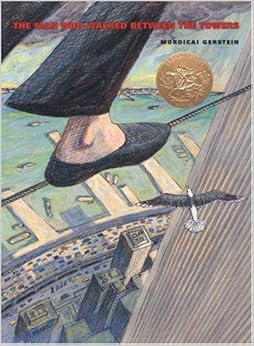
Module 3: The Man Who Walked Between the Towers


Book Summary
This 2004 Caldecott Medal winning book tells the story of the French man Philippe Petit who tight-rope walked between the Twin Towers in New York City. Using both visual and prose story telling, this book shows the daring steps Petit took back in 1974. Since the September 11 terrorist attacks, this book also makes a point of highlighting a joyful side of the lost towers. 

APA Reference of Book

Gerstein, M. (2003). The man who walked between the towers. United States: Roaring Book Press. 

Impression
This book is a fantastic book from both a curricular standpoint and from judgment of the illustrations. As the story progresses step by step of Petit's infamous walk between the towers, the illustrations are set in a frame-by-frame sequence. There are two pull out illustrations that show the expansive distance between the two towers and the massive height of the towers. Now that we have lost these towers, it is important to have literature that tells the story beyond the tragedy that brought them down. This story works as a biographical tale, historical context, and the power of great illustrations. 

Professional Review

Gerstein, Mordicai. The Man Who Walked between the Towers. 2003. 40p. illus. Roaring Brook, $17.95 (0-7613-1791-0); lib. ed., $24.90 (0-7613-2868-8). 791.3. PreS–Gr. 3. Here’s a joyful true story of the World Trade Center from a time of innocence before 9/11. In 1974 French trapeze artist Philippe Petit walked a tightrope suspended between the towers before they were completed. Gerstein’s simple words and dramatic ink-and-oil paintings capture the exhilarating feats, the mischief, and the daring of the astonishing young acrobat. He knew his plan was illegal, so he dressed as a construction worker, and, with the help of friends, lugged a reel of cable up the steps during the night and linked the buildings in the sky. As dawn broke, he stepped out on the wire and performed tricks above the city. Gerstein uses varied perspectives to tell the story—from the close-up jacket picture of one foot on the rope to the fold-out of Petit high above the traffic, swaying in the wind. Then there’s a quiet view of the city skyline now, empty of the towers, and an astonishing image of the tiny figure high on the wire between the ghostly buildings we remember. —Hazel Rochman

Rochman, H. (2003). The man who walked between the towers (book). Booklist, 100(5), 298. 


Library Uses
I think this book would be a great book to use as a story time during the week of September 11th. Another use would be in conjunction with a study on illustrations and the power of frames and/or proportions in illustrations.  

Wednesday, September 2, 2015

Module 2: The Cat Ate My Gymsuit


Book Summary
The Cat Ate My Gymsuit is Paula Danzinger's first novel. It tells the story of Marcy Lewis, a ninth grader at Dwight D. Eisenhower Junior High. Marcy's life is not one that she is happy with. She refers to herself as a blimp, has a rough relationship with her father, and does not feel included with the other kids at school. This changes when she gets a new English teacher, Ms. Finney, who changes her views and others views on the world and themselves. Everything seems to be getting better for Marcy until Ms. Finney is fired by the principal. The students in her class band together to support their teacher and learn a lot about themselves, lives, and standing up for what they believe. 

APA Reference of Book

Danzinger, P. (1974). The cat ate my gymsuit. New York: Puffin Books. 

Impression
I had a lot of mixed feelings on this book. but overall I really enjoyed it. I found Marcy to be unnecessarily angsty and was annoyed by her attitude at the beginning of the book. However, as Marcy began to change and grow more confident, I found her much more likable. I think she would be very relatable for the average middle class child who feels everything in their life is terrible, despite them being very well off. I thought Marcy's parents were caricatures of the angry, stubborn father and the helpless mother. I wished there were more character development for them and possibly a back story given to explain some of their actions. The other characters were likable and I felt they added depth and complexity to the story. Despite this story having some dated aspects (like who even wears a gymsuit anymore!), I would consider it a young adult classic, as there are many themes that will connect to readers for generations to come. My favorite part of this book was that it provided a window into the time it was written. This window was simply into an average person's life. Often times books written in the 1970s provide historical context and situations. While I love historical fiction, I thought that leaving historical events out of this story makes it much more of a classic.

Professional Review
"Gr. 5-8. Published in 1974 and considered a "modern classic," Danziger's novel about overweight teenager Marcy Lewis is an excellent choice for a multicast performance. The story contains lots of dialogue and characters with distinct personalities. Written during an era when calling oneself "Ms." was radical, principals unilaterally suspended students, and adults routinely smoked cigars and cigarettes, the story holds up amazingly well. The shining star in this production is Caitlin Brodnick, who plays Marcy to perfection. She never overplays her role as the bright teenager whose self-image is so low that she refuses to participate in gym class because she doesn't want others to see her in a gym suit. The other youthful actors-Spencer Murphy, who reads the part of Joel Anderson, and Katie Reed, as Nancy Sheridan-are believable as well. Except for Marcy's younger brother, whose babylike speech seems a bit unnatural, all characters come off as credible and authentic, including Marcy's put-upon mother and Ms. Finney, the beloved teacher who is suspended for refusing to say the"Pledge of Allegiance." Piano-music interludes announce chapter changes. Concluding remarks bythe late Danziger, in which she tells how she came to write this debut novel, elevate this sterling 2005 Selected Audiobooks for Young Adults choice. -Sue-Ellen Beauregard"
Beauregard, S. (2005). The cat ate my gymsuit. The Booklist, 101(15), 1400.
Library Uses
I think this would be a good edition to a young adult book club that would be held at either a public library or a lunch book club to be held in a middle or high school library. While it is an older book that might not initially be interesting to young readers, the themes in the book connect across generations and to other young adult novels. It would best to pair this book with a more recent YA book that covers the same themes, but in a different manner.