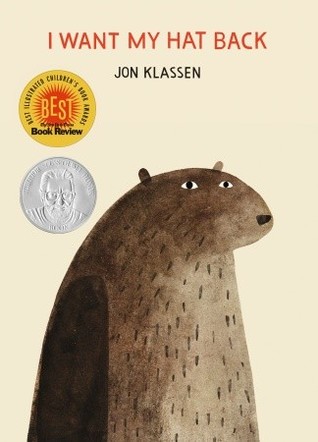
Book Summary
In this book, a bear is on the search for his beloved hat. He makes his way through the forest stopping other animals inquiring about at, until suddenly he realizes that he's already seen it!
APA Reference of the Book
Klassen, J. (2011). I want my hat back. Somerville, MA: Candelwick Press.
Impression
I was first interested in reading this book because I had really enjoyed the companion book This is Not My Hat. For younger students, I initially liked this book because of the repetition. But as I continued through the book, I, as an adult, thought this book was hilarious. I love the dialogue, especially from the guilty rabbit. The humor in this book is very dry, which is the type of humor I find very funny. The way Klassen uses the use of red in his illustrations to move the plot along is very clever.
Professional Review
An original and dark picture book. Although the illustrations are static with only occasional bursts of energy they are powerful and engaging and have a wonderful clarity. The bear has lost his beloved hat, a little triangular red hat, and he asks many of his neighbours if they have seen it. All deny any knowledge of it including the rabbit who seems to be actually wearing it. The bear, not too observant, does not notice and then his vision of the rabbit suddenly returns--on an inspired all red page--and he storms off to locate the offending creature.
Jon Klassen is a Canadian illustrator and animator. His book has received much praise in the US and Canada where it was published shortly before Walker's UK edition. It seems certain that it will create great interest and receive similar praise on this side of the Atlantic. Jon Klassen is to be welcomed into a select group of picture book storytellers with a unique illustrative style. The book can be thoroughly recommended over a wide age range.
Holloway, M. (2012). Klassen, Jon: I want my hat back. School Librarian, 60(1), 27.
Holloway, M. (2012). Klassen, Jon: I want my hat back. School Librarian, 60(1), 27.
Library Uses
This would be a great book to do for an upper elementary read aloud. As students get older, there is pressure to have library lessons that are useful and applicable to skills that will be used on STAAR. This book would be excellent in teaching students how to infer, use dialogue and add tone to their writing.

No comments:
Post a Comment